LEARN THE ANIMAL'S RHYTHM
Wild animals live inside an uninterrupted stream of risk assessments. Every scent molecule carried by the wind, every snapping dry twig, and every dark silhouette on the horizon is weighed against survival. To observe without disruption, the naturalist must learn this silent lexicon.
THE THRESHOLD OF ALERTNESS
Observation begins by categorizing behaviour into four distinct baseline states: Relaxed/Nutritive, Inquisitive Alert, Critical Alert, and Evasion. Many casual photographers miss the inquisitive alert, assuming that because an animal has not fled, it remains comfortable with proximity.
An animal caught in an alert posture stops chewing, dilates its pupils, points ears forward, and stiffens its spine. This state consumes vital attention that should be devoted to foraging or kit care. Continuing to advance during this phase guarantees an eventual stress-induced flight response.
- RELAXED Head down foraging, grooming coats, slow reciprocal vocalizations.
- INQUISITIVE Chewing pauses, head elevates, scanning downwind.
- CRITICAL Stamping, alarm calls, scent testing, crouched stance.
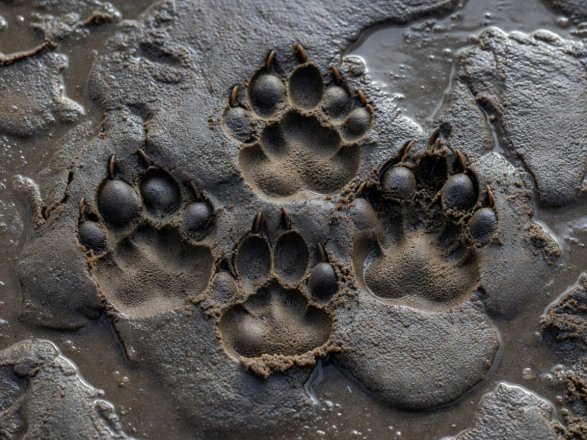 Riverbank sand prints: identifying passage timing without lingering near sensitive water entries.
AVIAN PRE-FLIGHT TELLS
Birds are particularly vulnerable to sudden human intrusion, especially during winter months when every burst of flight expends scarce metabolic reserves. Wading birds feeding along mudflats exhibit minute behavioural cues before taking off in alarm.
Watch for the "feather shake" or sudden defecation, followed by rapid eye blinking and repetitive neck extension. If a curlew or godwit turns its chest directly into the wind while looking over its shoulder at your position, it is calculating takeoff trajectory. Back away immediately to permit uninterrupted feeding.
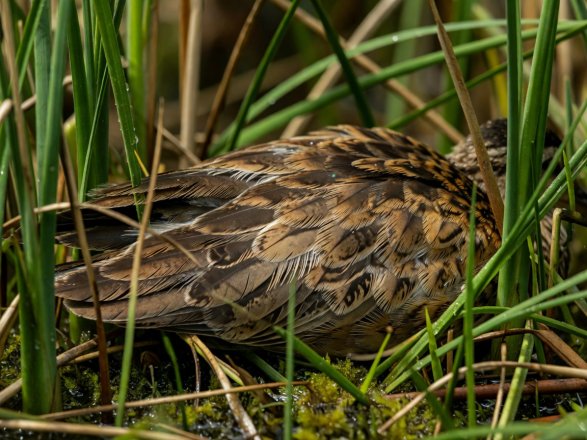 Moulting feathers in shoreline sedges provide behavioral context of seasonal cycles.
SPECIES-SPECIFIC STRESS RESPONSES
Use this diagnostic reference to identify early physiological agitation across common temperate biomes.
| Family / Group | Comfort Baseline | Early Stress Indicator | Action Required |
|---|---|---|---|
| Cervids (Roe / Red Deer) | Continuous cud-chewing, ears rotating independently | Bilateral ear lock, foreleg stamping, nostrils flared | Crouch low, freeze movement, withdraw downwind |
| Mustelids (Otters / Badgers) | Steady rhythmic diving, systematic rock turning | Treading water with snout raised, sudden periscope dives | Avert lens reflection, retreat behind river bank |
| Wading Birds (Curlews / Plovers) | Slow systematic probing in soft mud substrates | Head-bobbing, repetitive single-note alarm whistles | Halt immediately, lower silhouette, retreat 50m |
| Raptors (Owls / Harriers) | Rhythmic side-to-side scanning from elevated perches | Elongated neck, compressed plumage, direct pupil lock | Cease shutter clicks, avoid walking into perch sightlines |